
Explore the Latest UAE Labour Law 2026

The relationship between employer and employee is crucial, which is why the United Arab Emirates has significantly updated its labour regulations to create a more flexible and secure work environment. The new UAE labour law, officially known as Federal Decree-Law No. 33 of 2021, replaced the old Federal Law No. 8 of 1980, effective from February 2, 2022.
This new law sets out modern rules for private sector employment, affecting everything from job contracts to workplace policies. For both employers and employees, understanding these changes is essential, whether it’s knowing your contract terms or calculating your final dues with our gratuity calculator UAE.
The latest labour law aims to align with global standards and protect the rights of all parties involved. This guide will walk you through the key aspects of the new UAE labour law. I will also explain the important updates in simple terms, so you know exactly what your rights and obligations are.
Every one of the employees in private businesses must now work with fixed-term contracts, but no more unlimited contracts. Private sector companies today also provide numerous sorts of employment, such as remote, part-time, flexible, and temporary positions. The government is pushing companies to hire Emirati nationals using Emiratisation targets, implements sanctions for not achieving Emiratisation targets, and provides a financial backstop for employees who are terminated, because of the introduction of the ILS (Indemnity of the Employment Industry) program.
The emphasis on stricter enforcement and promotion of equal pay and anti-discrimination laws, digitisation of labour services including e-contracts and e-signing of documents, as well as stricter enforcement of WPS (Wage Protection System) in relation to timely payment of wages, will result in an accelerated penalty system for private companies that fail to meet the payroll requirements in a timely manner.
What is the new UAE labour law?
As the name suggests, the UAE labour law manages the relationship between employers and employees in the private sector within the United Arab Emirates, ensuring a fair working environment for both parties.
Think of it as the official rulebook and guidelines for the workplace, ensuring that business runs smoothly and every employee and official is treated fairly. It is formally known as Federal Decree-Law No. 33 of 2021.
It sets clear guidelines for:
The main purpose of these latest labour law rules is to create a stable and productive work environment by clearly defining the rights and duties of both the employer and the employee.
UAE Labour Law has created a more modern and open system of labour relations. There are now more detailed descriptions of each employee’s rights and a higher degree of liability placed on an employer to follow the letter of the law with respect to the rights of employees. The intent of labour law is to create a job market that is more adaptive to change and rapid development while delivering fair and well-regulated working conditions for all workers.
11 Things You Should Know about UAE Labour Law
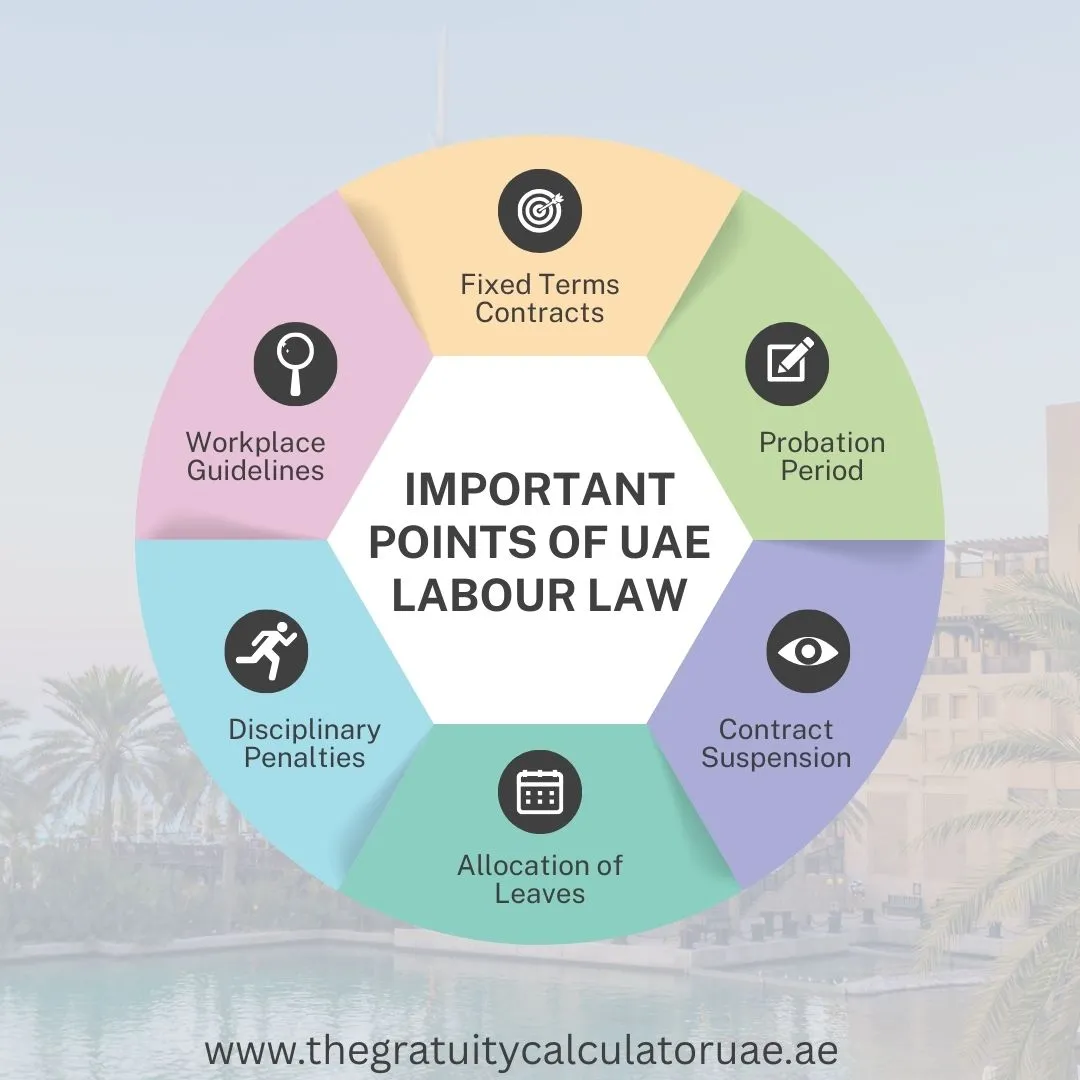
The new labour law in the UAE brings many important changes that affect every part of your job. From the type of contract you sign to the different kinds of leave you can take, these updates are designed to make the workplace more modern and fair.
I’ll help you break down the most significant points you need to know about while working in the UAE.
Fixed Term Contracts
One of the biggest changes in the new UAE labour law is the removal of unlimited contracts. Effective from February 02, 2022, all private sector companies must hire employees on fixed-term contracts. Companies were given a deadline until February 2023 to move all their employees from old unlimited contracts to these new fixed-term agreements.
The UAE’s employment sector offers contracts that may be renewed as often as agreed on between the employee and employer.
Probation Period
A probation period is considered a trial run for both you and your employer. The probation period can be a maximum of six months, and your employer cannot extend it beyond this, as per the latest UAE labour law.
The biggest change in the UAE’s new labour law is about the notice period. Now, both the employer and the employee must give a written notice if they want to end the contract during the probation period.
The strict enforcement of the law related to notice periods for both employer and employee during probationary employment began to be enforced.
Confused? Let’s make it easy:
UAE Working Hours
The latest UAE labour law makes the work week more flexible for employees. Your off day doesn’t always need to be Friday, as it can be any day your company agrees to in your employment contract.
If you work extra hours other than normal duty hours (8 hours), there are clear rules for overtime. You can’t work more than 144 overtime hours in 3 weeks, and you get paid extra for it. For your annual holidays, you should use them in the same year.
According to the new law, you can also agree with your employer to carry unused annual leave or get paid for any unused days based on your basic salary. Employees will get unused annual leave in their full and final settlement.
In most cases (private and public), the workings of the UAE have changed to a five-day working week, which follows the accepted international Mon-Fri work standard; however, the employer’s discretion remains to set the days off in relation to his or her business needs.
The continuing interest in providing flexible working hours, which both the employer and employee may negotiate (at their discretion) to make both employee and employer successful while complying with all laws and regulations.
Allocation of Leaves
The new UAE labour law ensures that employees enjoy their lives outside of the working environment and office politics. To support employees during important life events, the UAE labour law provides several different types of paid and unpaid leave.
Here’s a quick look at the main leave entitlements;
Maternity Leave
UAE’s new labour law provides significant support for working mothers. Female employees are entitled to a total of 60 days of maternity leave. Here’s the breakdown;
First 45 days: You will receive your full salary.
Next 15 days: You will receive your half salary.
After these 60 days, if you or your child has a medical issue related to the pregnancy or birth, you can take an additional 45 days of unpaid leave. You will need a medical certificate or a certified doctor’s prescription to apply for this extra leave.
Special Support: The UAE law also provides extra help for mothers of children with disabilities (referred to as ‘people of determination’). In such cases, you are entitled to an additional 30 days of fully paid leave after your initial maternity leave ends. This can be further extended by another 30 days of unpaid leave.
Mothers who return to work will benefit from the enforcement of a daily break to breastfeed their baby; this has made it easier on the working mother and employer to meet each other’s childcare and work-life obligations.
Sick Leave
Once you have completed your probation period, you are entitled to 90 days of sick leave under the AE in a year if you are unwell. It’s important to inform your employer in writing within 3 days of falling ill and provide a medical report to support your leave application.
The payment for these 90 days is as follows:
First 15 days: You will receive your full salary.
Next 30 days: You will receive half of your salary.
Final 45 days: This period will be unpaid.
Sick Leave Policies are now subject to increased monitoring by employers. Therefore, employees must furnish appropriate medical documentation when taking Sick Leave. Any violation of the Sick Leave laws may lead to employee disciplinary actions pursuant to UAE Labour Laws.
Annual Leave
You are entitled to fully paid annual leave to rest, recharge, and regain energy to work. The number of annual leaves you get depends on how long you have worked for your employer. Here’s the breakdown of Annual Leave;
If you have worked for more than one year, you get 30 days of paid annual leave.
If you have worked for more than six months (but less than a year), you get 2 days of paid leave for every month you have worked.
Pro Tip: Use your leave within the year you get it. However, you can agree with your employer to either carry over your unused annual leave to the next year or get paid for it annually if any company policy exists for it.
If you get paid for unused leave at the end of your service, the payment is calculated based on your basic salary only.
Parental Leave
To support new parents, the UAE was the first Arab country to introduce parental leave for the private sector! Both mothers and fathers are entitled to 5 working days of paid leave after the birth of their child. This is also called paternity leave.
This leave can be taken consecutively or on separate days, but it must be used within the first six months after the child’s birth. This initiative in the new labour law of the UAE allows parents to spend important time with their newborn baby!
Hajj Leave
The UAE Labour Law respects the religious obligations of employees. To perform the Hajj pilgrimage, you are entitled to 30 unpaid Hajj leave.
A key point to remember is that this is a once-in-a-lifetime benefit; you can only take this special leave once during your entire employment with a single company in the United Arab Emirates. But if your company policy allows for another Hajj, go for it!
Umrah Leave
It is important to know that the UAE labour law does not have a separate provision for Umrah leave in the UAE. This means your employer is not legally required to give you special leave to perform Umrah.
However, many companies are supportive of their employees’ religious practices. You can always request time off for Umrah from your employer. It is up to the company’s internal policy to decide whether to grant this leave as part of your annual leave or as unpaid leave!
Study Leave
The new Employment Act in the UAE supports employees who are continuing their education along with their job. The UAE government encourages employees to enhance their skill set and educational abilities. UAE employees can take special study leave (paid/unpaid, varies company to company), but you must meet a few conditions:
Documentation for examination or school obligations may need to be provided by employees, as employers are starting to align the benefit of Study Leave with performance and skills development objectives.
Leave to Find a Job
If you are serving your notice period, you are entitled to one day of unpaid leave per week to look for a new job.
This will help you attend interviews and secure your next role without having to use your annual leave. To use this leave, you should coordinate with your employer to schedule your day off.
If your contract has been terminated by your employer, you are entitled to one unpaid day per week of your notification period to conduct search activities for employment, which would include going to interviews or seeking new opportunities.
In order to utilize this benefit, you must inform your employer of your intention to take advantage of this benefit before you take the benefit, and coordinate the timing with your employer. This benefit is not guaranteed if you voluntarily resign and is subject to your Employer’s or company’s Policy Discretion.
Compassionate Leave
The UAE Labour Law provides paid time off, also known as bereavement leave, to support you during the difficult time of losing a family member. The number of days you get depends on your relationship to the deceased. However, here are the terms and conditions for your understanding;
In the case of the death of a spouse, you are entitled to 5 days of paid leave.
In the case of the death of a parent, child, sibling, grandchild, or grandparent, you are entitled to 3 days of paid leave.
This leave is given so you have time to manage personal matters and grieve without worrying about losing your salary.
Contract Termination Rules
Under the new UAE labour law (Federal Decree-Law No. 33 of 2021), the rules for ending a contract are now much simpler. If either you or your employer wants to end the contract, a written notice must be given.
The length of this notice period is simply what is written in your job contract. The only rule is that it must be between 30 and 90 days.
It is important to understand that the old system, which many people still remember, is no longer used.
The old rule was based on your years of service:
- 30 days’ notice for less than 5 years of service
- 60 days’ notice for 5-10 years of service
- 90 days’ notice for more than 10 years of service
Again, remember that this old system has been replaced. Always check your current contract for the correct notice period.
The regulations regarding the enforcement of notice periods have become more stringent. If you do not provide the appropriate notice while terminating your employment, you could be responsible for paying your employer the equivalent number of days in your notice period.
Rules for Contract Suspension
If an employee violates company rules, the employer has the right to temporarily suspend them from work to conduct a proper internal investigation.
A serious violation could include things like revealing company secrets, causing significant financial loss, or breaking safety rules. During this time, the suspension can last for up to 30 days, and the employee is paid half of their salary.
However, the latest labour law protects the employee from unfair suspension. If the investigation finds that the employee is innocent in all ways, the employer must pay them the remaining half of their salary for the suspension period.
UAE Gratuity Calculation 2026
Your end-of-service gratuity is a ‘thank you’ payment from your employer for your service. If you have completed at least one year of service, you are eligible for the gratuity payment.
The calculation of gratuity in salary is based on your last drawn basic salary and is split into two parts:
For your first five years of service, you get 21 days’ basic salary for each year.
For any years of service after the fifth year, you get 30 days’ basic salary for each additional year.
To get an exact gratuity figure without any complicated math, you can always use our gratuity calculator tool. As per UAE labour law, it’s important to know that your employer must pay your full and final settlement, including your gratuity, within 14 days of your last working day.
The UAE law is very clear on gratuity payment. Your employer must pay your full and final settlement, including your gratuity, within 14 days of your last working day. Submitting a formal application for gratuity by an employee helps ensure this deadline is met and you receive your dues promptly.
Currency of Salary Payments
The new labour law provides more flexibility when it comes to the currency of your salary. According to the old labour law, employees were paid the FFS amount in the UAE Dirham (AED). Still, as per the new labour law, employers can now pay you in any other currency, such as the Dollar, the Euro, the INR, the PKR, etc., if you both agree to it in the employment contract.
To ensure that employees are paid on time, most companies are required to pay salaries through the Wages Protection System (WPS). This is an electronic system that transfers your salary directly to your bank account. Using the WPS is mandatory, and companies that fail to use it can face fines and penalties.
Workplace Guidelines
The new UAE labour law places a strong emphasis on creating a fair, respectful, and safe work environment for everyone. It strictly prohibits any form of discrimination and harassment in the workplace.
Here are the key protections under the law:
Equal Opportunity: Employers cannot discriminate against people based on their race, colour, gender, height, body, religion, nationality, social origin, or disability. This rule applies to all types of employment.
Equal Pay: The new law ensures that men and women receive equal pay for the same work they do.
Protection for Women: It is illegal and unethical for an employer to terminate a female employee’s contract because she is pregnant or on maternity leave.
The labour law in the UAE also makes it clear that employers are responsible for preventing any form of harassment, bullying, or any verbal, physical, or psychological violence against their employees in the workplace.
Disciplinary Penalties
The UAE Labour Law gives employers the right to apply penalties if an employee breaks the company’s rules. However, these penalties must be fair and can only be given after a formal investigation where the employee has a chance to explain their side.
According to Article 39 of the law, an employer can apply the following penalties, usually in order of seriousness:
Written Notice: A formal letter pointing out the mistake (a verbal warning can also be given).
Written Warning: A more serious formal letter warning the employee.
Deduction from Salary: A deduction of not more than 5 days’ salary in a single month.
Suspension from Work: Suspension without pay for up to 14 days.
Denial of Annual Increment: The employee may not receive their yearly salary increase for one year.
Denial of Promotion: The employee may be denied a promotion for up to two years.
Termination: In cases of serious misconduct, the employer can terminate the contract while still paying the end-of-service gratuity.
It’s important to know that an employer cannot accuse an employee of a violation more than 30 days after it was discovered.
Disciplinary actions must be properly documented in accordance with the company’s policies, as established by the authorities, and must comply with those policies. If you believe your disciplinary action was unfairly imposed upon you, you may submit a complaint to the MOHRE.
Unemployment Insurance Scheme
A major addition to the UAE’s employee support system is the mandatory Unemployment Insurance Scheme, which was introduced back in 2023 to provide a safety net for workers who lose their jobs.
This scheme gives you a temporary income if you become unemployed, which helps you manage your kitchen income while you look for a new job. It is also known as compensation for the termination of employment in the UAE.
Here’s what you need to know:
Subscribe: It is mandatory for all employees in the private and federal government sectors to subscribe to this scheme.
Cost: The cost is very low, starting from just AED 5 per month for employees with a basic salary of AED 16,000 or less.
Benefit: If you lose your job, you can receive a cash payment equal to 60% of your basic salary in the UAE, up to a maximum of AED 20,000 per month. This benefit is paid for a maximum of three consecutive months.
Eligibility: The scheme does not apply to investors, domestic workers, temporary contract employees, or employees in free zones.
To be eligible to claim the benefit, you must have been subscribed to the scheme for at least 12 continuous months. This is a crucial step in providing financial security for employees across the UAE.
UAE Public Holidays
Under the UAE labour law, all employees in the private sector are entitled to fully paid leave on official UAE public holidays. This ensures that employees receive time off for national and religious holidays and spend more precious time with their families and loved ones.
Here is a list of the UAE public holidays:
|
Holiday Name |
Number of Days |
|---|---|
|
Gregorian New Year |
1 day (January 1) |
|
Eid Al Fitr |
4 Days |
|
Arafat Day & Eid Al Adha |
4 Days |
|
Hijri New Year (Islamic New Year) |
1 Day |
|
Prophet Mohammed’s Birthday |
1 Day |
|
Commemoration Day |
1 day (December 1) |
|
National Day |
2 days (December 2 & 3) |
It’s important to remember that the exact dates for Islamic holidays (like Eid and the Hijri New Year) change every year because they are based on the sighting of the moon.
UAE Wages
The UAE labour law has very clear rules to make sure employees are paid correctly and on time as per MOHRE guidelines.
Your salary amount must be clearly written in your employment contract, and it is your employer’s responsibility to pay it as agreed in the time of employment contract.
Here are the most important rules about your wages:
Payment Timeline
Unless your employment contract states otherwise, your salary is due on the first day of the month after you have completed the work.
Salaries will be paid through the Wages Protection System (WPS). If an employee experiences a delay in receiving their salary after the date agreed upon, the employer will incur a penalty or restriction. In accordance with WPS Guidelines, individual salary payment periods are based on the contracts signed with each employee.
Payment Source
All private companies must pay their employees through the Wages Protection System (WPS). This is a secure electronic system that transfers your salary to an authorised bank.
Transferring salary through WPS creates an official record as MOHRE doesn’t perform any transaction itself. Moreover, companies that don’t use the WPS can face heavy fines.
UAE Job Levels
To better manage the jobs in industries, the Ministry of Human Resources and Emiratisation (MOHRE) classifies all jobs into nine professional levels. These levels are important because they help determine the skill category of a job, which can affect visa applications and other requirements.
Here are the nine official job levels in the UAE:
|
Job Level |
Category Description |
|---|---|
|
Level 1 |
Legislators, Managers, and Business Executives |
|
Level 2 |
Professionals in Scientific, Technical, and Human Fields |
|
Level 3 |
Technicians in Scientific, Technical, and Humanitarian Fields |
|
Level 4 |
Writing Professionals |
|
Level 5 |
Service and Sales Occupations |
|
Level 6 |
Skilled Workers in Agriculture, Fisheries, and Animal Husbandry |
|
Level 7 |
Craftsmen in Construction, Mining, and Other Crafts |
|
Level 8 |
Machine and Equipment Operators and Assemblers |
|
Level 9 |
Basic Occupations / Helping Hands |
Your job is officially classified as “Skilled Work” if it meets all of the following conditions:
This distinction is important as many work permits and visa types are specifically for employees in skilled professions.
2 New Employee Benefits in the UAE Labour Law
Here are the most important benefits you are entitled to as an employee in the UAE.
Health Insurance
Health is wealth! In the UAE, your health is a top priority. The new law requires employers in Dubai and Abu Dhabi to provide their employees with at least a basic level of health insurance coverage.
A very important rule is that your employer must pay for this insurance premium themselves. They are not allowed to deduct the cost from your salary or reduce your pay to cover it.
While the law in these Emirates mandates coverage for the employee, it doesn’t always require the employer to cover the employee’s family or dependents. However, it is a legal requirement for every single resident in the UAE to have valid health insurance.
Many people have their proof of valid insurance correlated with their visa issuance and renewal processes, so they can maintain consistent coverage throughout their working/settling here in the UAE, regardless of when these occur.
Insurance System For Workers
To protect the financial rights of employees, especially your end-of-service benefits, the UAE has a special system in place. When hiring a new employee, your employer must choose one of two options to guarantee your dues:
Bank Guarantee: They can provide a bank guarantee of AED 3,000 for each employee. This money is kept aside to pay you if the company fails to do so.
Insurance Policy: As a more modern and cost-effective alternative, they can buy an insurance policy for you. This policy, often called “Taa-meen,” is much cheaper for the employer but provides significant coverage for you.
This insurance policy protects your entitlements and can cover up to AED 20,000 for things like unpaid wages, your end-of-service gratuity, the cost of a flight ticket home, and work-related injuries.
Workplace Health and Safety

As per UAE labour law, your employer is responsible for providing a safe and appropriate work environment.
Here’s what your employer must provide:
A Safe Workplace: This includes providing safety instructions, proper safety gear (like helmets or gloves), and ensuring the workplace is clean and hygienic.
Protection from Heat (The Midday Break): To protect outdoor workers from extreme summer heat, the law enforces a mandatory “midday break.” From June 15 to September 15 every year, it is illegal for employees to work outdoors between 12:30 PM and 3:00 PM.
Reporting Injuries: If you suffer any work-related injury or illness, it is your employer’s duty to report it to the Ministry of Human Resources and Emiratisation (MOHRE). They are also responsible for covering the costs of your medical treatment for any such injury.
Non-Compete Restrictions
A non-compete clause is an agreement in your contract that stops you from working for a competitor or starting a similar business after you leave your job. The new UAE labour law allows employers to include this, but only if it’s fair and necessary to protect their business secrets or customer relationships.
For a non-compete clause to be valid, it must be very specific and reasonable about three things:
Time: The restriction cannot last for more than two years after your contract ends.
Place: It must define the specific geographical area where you cannot compete (e.g., a particular city or Emirate).
Nature of Work: It must clearly state the type of work you are not allowed to do.
Important Note: A non-compete clause is only valid if your employer has a legitimate reason to protect their business. If your employer terminates your contract without a valid reason under the law, the non-compete clause will not be enforceable under any conditions.
Emiratisation Rules & Targets
The UAE Government has increased the need for local Emirati participation within the workforce through the implementation of Emiratisation rules. Therefore, any company with 50 or more employees must adhere to a minimum target supply of hiring Emiratis.
Those targets increase every year, leading up to a penalty for non-compliance. In addition, if non-compliance occurs, fines and ineligibility for work permits, etc., may be imposed upon a company.
These initiatives are intended to increase available jobs for Emiratis while ensuring balanced, inclusive workforces.
Minimum Wage for Emiratis
A minimum wage for employees of Emirati nationality working in the private sector is part of the latest changes that the UAE has put into effect. By 2026, the minimum salary will be AED 6,000 monthly.
This regulation is designed to guarantee that Emirati nationals receive fair compensation and to help those nationals maintain financial stability. In addition, it will further encourage businesses to offer competitive wages and uphold equitable employment standards throughout the employee base.
Voluntary End-of-Service Savings Scheme
Along with the conventional gratuity system, the UAE has also introduced a voluntary employee savings program for UAE employees. Through this program, the employer will have the option of investing in an employee’s savings plan rather than paying a one-time gratuity upon completion of service.
This will ultimately allow an employee’s savings to grow over time while providing them with improved financial security. This program is voluntary to employers who may elect to continue the traditional gratuity system or to implement the new method.
Stronger Penalties & Compliance Rules
A recently passed increase in penalties under the UAE’s labour laws will help enforce companies’ compliance with required regulations. As we move forward with enhanced enforcement of the law, there will be increased penalties imposed for violations of minimum wage statutory requirements, not meeting Emiratisation quotas, and other labour law violations or non-compliances.
Severe labour law violations could mean a penalty as high as AED 1 Million plus restrictions on companies’ ability to continue operation. These stringent labour regulations create a fair, open work environment for each employee.
Digital Labour Services in the UAE
The UAE continues to evolve into a more progressive labour market by providing digital services to both employees and employers. Employees will be able to conduct many functions, including employment contract requests, obtaining approval requests, filing complaints, etc., via official electronic service delivery platforms.
The transition to the use of digital service delivery will allow easier access to services, the elimination of much of the paper traditionally required to fulfil services, and provide for faster resolution of issues that have arisen within the employment context. It will also provide greater transparency and efficiency in the management and delivery of employment services.
Final Words
The new UAE labour law is a big step in making the country’s job market more modern, fair, and efficient for everyone.
By introducing clear rules on everything from contracts and leaves to workplace safety, the new labour law creates a better balance between the rights of employees and the needs of employers.
As a legal consultant, I created this guide to give you that knowledge in simple terms, so you can feel confident and secure in the UAE.
With the UAE Labour Laws always growing, changing, and with stricter enforcement of such, it’s essential that both employees and employers are up-to-date on current regulations.